

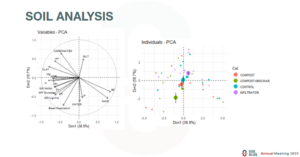
Preliminary results from experiments with organic amendments developed within the European Soil O-Live project show that olive trees treated with a mixture of biochar and compost applied via an infiltrator increase their oil production per tree by 7% to 24% compared to trees not treated with this organic amendment. The biochar used in the tests is from Carboliva, a partner company in the Soil O-Live project. The research yielding these results was conducted on three different farms located in the towns of Baena (Córdoba), Torreperogil (Jaén), and Chiclana del Segura (Jaén). Remediation treatments were tested on groups of four olive trees: one received no treatment, another received only compost, the third had compost and biochar spread around the tree, and the fourth used the same mixture but inside an infiltrator. One year later, it is evident that the latter tree produces, on average, between 0.4 and 1.7 kilograms more oil than the olive tree to which nothing was applied, representing the aforementioned increase of 7% to 24%. Dryland olive groves achieved the best results in these experiments in terms of yield. Furthermore, it is evident that the soil has improved regarding organic matter, respiration, and water retention, especially in the trees where compost and biochar were spread.

These conclusions were presented at a meeting held between the coordinator of Soil O-Live and Professor of Ecology at the UJA, Antonio Manzaneda; project researchers Víctor Valenzuela and Mar Isabel Reyes; and the heads of Carboliva, Álvaro and Beatriz Espuny.
Manzaneda explained that these experiments with such promising results will continue on the aforementioned farms and will also be extended to other experimental sites in Italy, Greece, and Portugal that are also participating in the project. “We are satisfied with these initial results from the remediation experiments, as they demonstrate that organic amendments improve soil quality and have great potential to increase olive production in certain agronomic contexts,” Manzaneda stated.
Álvaro Espuny, CEO of Carboliva, highlighted that this experiment demonstrates how positive biochar is for olive trees and how it serves as a fully sustainable solution. “At Carboliva, we produce our biochar from olive biomass (pits and pulp), and it returns to the tree, providing nutrition that makes it more profitable,” underlined the head of Carboliva, who also mentioned that the benefits of biochar last for decades.
Soil O-Live and Carboliva will continue to collaborate in the second part of this project led by the University of Jaén, which, after analyzing Mediterranean olive grove soil, is now focusing on the implementation of remediation and rehabilitation solutions.
